
Cave Diving at Cenote X’Batún
Where jungle roots meet the Mayan underworld
A Window Into an Ancient World
X’Batún is one of two underwater caves located at San Antonio Mulix, a small Mayan community in southern Yucatán that has become an unlikely centre of cave diving on the inland peninsula. The two cenotes — X’Batún and its semi-closed sister, Dzonbacal — sit roughly 800 metres apart, connected by a forest path and a shared cooperative that manages both sites with quiet, careful stewardship.
X’Batún is of the open free-fall type, with a particularly scenic view created by tree roots hanging over the cave entrance. A stone staircase of approximately 20 metres leads down to the water, which glows a vivid blue and measures about 5 metres long by 25 metres wide. But the true drama of the place reveals itself only once you slip beneath the surface.
What lies beneath that modest surface opening is a gateway into something far grander. X’Batún serves as the entrance to an expansive underwater cave system, part of the vast karst network that threads through the entire Yucatán Peninsula like an ancient subterranean river atlas. The cenote plunges to a maximum depth of 70 metres — well into technical diving territory, and a reminder that what looks like a jungle swimming hole on the surface is anything but.
Born of Meteor and Millennia
The story of Yucatán’s cenotes begins with a shock event: the Chicxulub meteor impact 66 million years ago. At that time, the Gulf of Mexico and the Caribbean were one shallow tropical ocean, full of coral reefs — until a massive meteor smashed into them. Over millions of years, that crater filled in with debris and was buried under new layers of limestone from the returning ocean. However, the deep, circular fracture zones created by the impact remained hidden below.
The limestone that blanketed this fractured foundation became the medium for something extraordinary. Over thousands of years, rainwater seeped into the ground, slowly dissolving the limestone and creating extensive underground river systems and caverns. When the roofs of these caverns eventually collapsed, they exposed the water beneath — forming cenotes. The cenotes of the Yucatán are linked to one another by an extensive network of underwater rivers, creating one of the largest subterranean aquatic systems on Earth. Over thousands of years, dripping water inside these cave systems also resulted in the creation of breathtaking stalactites and stalagmites, adding to their otherworldly charm and making each dive a unique exploration of natural artistry.
The Dive Itself
With a maximum depth of 70 metres, X’Batún spans a wide range of diving experiences depending on certification and ambition. The upper sections — bathed in the turquoise glow filtering through the jungle canopy above — are accessible to advanced open water divers, offering dramatic cave formations, hanging root systems, and the remarkable aquatic vegetation that sets this cenote apart. Below the cavern zone, the cave deepens into technical territory. At 70 metres, X’Batún sits alongside some of the more demanding dives in the Yucatán — not the extreme depths of The Pit, which plunges to 120 metres, or the Blue Abyss at 112 metres, but deep enough to require trimix gas planning, decompression stops, and the kind of methodical preparation that distinguishes technical divers from recreational ones.
At X’Batún, the halocline — the visible boundary between freshwater and denser saltwater — sits unusually deep, between 50 and 55 metres. This means divers must be committed to a genuine technical descent before they encounter the shimmering, mirror-like interference layer that makes this phenomenon so visually arresting. The water temperature stays around a consistent 27°C throughout the water column, and aquatic vegetation — rare among cenotes — adds a living dimension seldom found in deeper cave passages.
Cascadas Blancas: A Chamber Newly Revealed
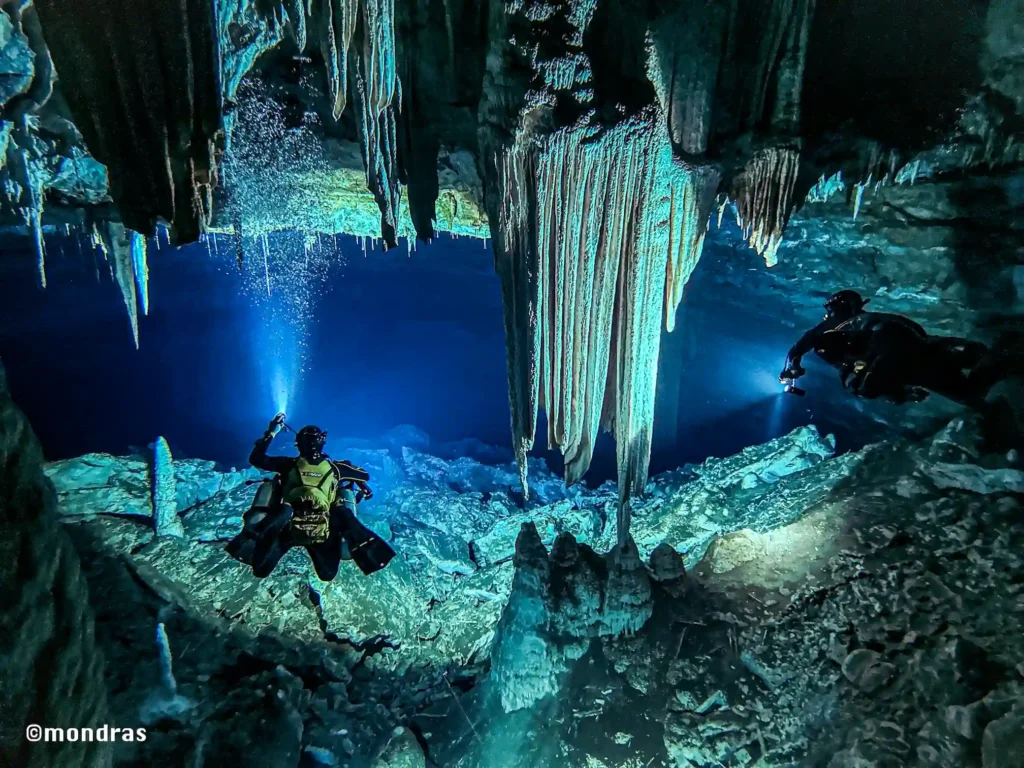
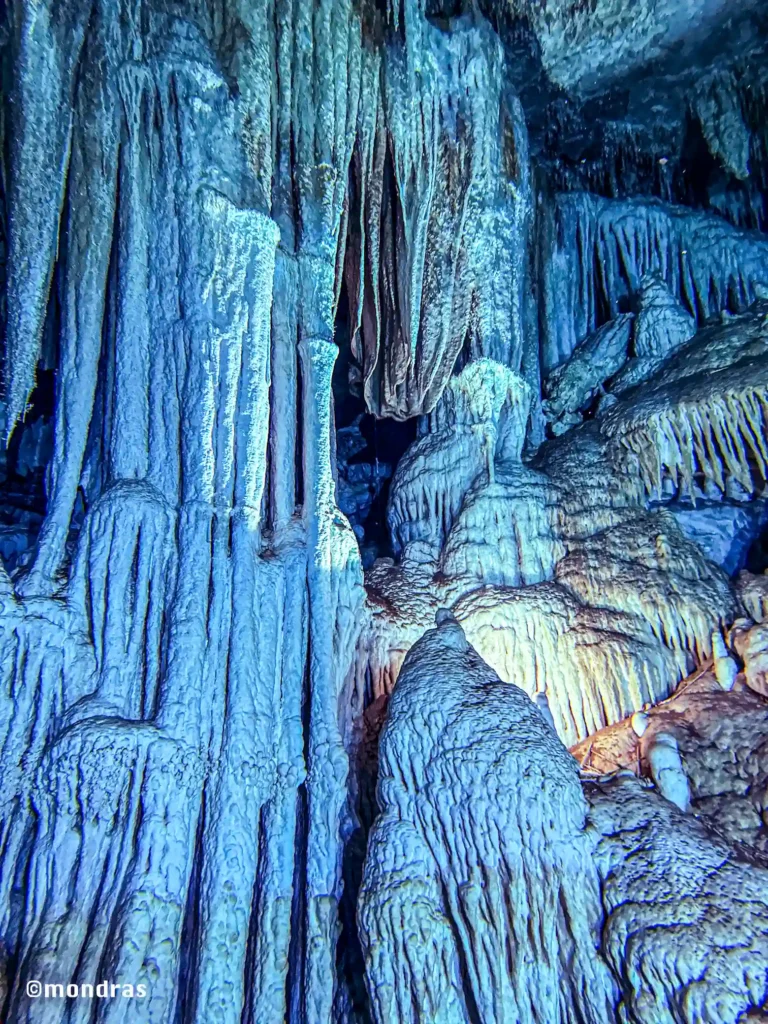
Among the most significant recent developments at X’Batún is the discovery of a chamber that local explorers have named Cascadas Blancas — “White Cascades.” The name is immediately understood by anyone who has seen it: pale curtains of flowstone and rimstone formations cascade down the chamber walls in frozen waves, the product of millennia of mineral-rich water depositing layer upon layer of white calcite. Under a dive light, the formations seem to glow from within.
The chamber was reached by pushing beyond the previously mapped sections of the cave system, through a restriction that had deterred earlier divers. What opened on the other side was a space of unexpected scale — a vaulted room with a formation density rarely seen even by experienced Yucatán cave divers.
Through two million years and over multiple glaciation cycles, these caves have been transformed. When the sea level was high, the caves flooded and their reach expanded. During the ice ages, the caves dried out as the sea level dropped, and the seeping water from the surface decorated the caverns with mineral deposits. Cascadas Blancas is a direct product of that cycle — its white formations built up during ancient dry periods and now preserved underwater, untouched for thousands of years until the first diver’s light swept across them.
The chamber currently sits outside the permitted recreational routes and is accessible only to fully certified cave divers with prior authorisation from the site cooperative. Survey work is ongoing, and the full extent of Cascadas Blancas — including whether it connects to other known passages in the region — has yet to be established.
Sacred Waters
The cenotes of Yucatán have never been merely geological features. Cenotes were once sacred places of the Maya, said to represent entrances to the underworld, known as Xibalba. X’Batún, tucked away from commercialisation near the ancient Puuc archaeological zone, still carries something of that sacred atmosphere — a hush that the busier cenotes near Cancún have long since lost.
Getting There and Diving Safely
Located on a rustic ranch near the Ruta Puuc, X’Batún offers a serene, less-crowded experience with a wooden deck and lush surroundings. It sits about 53 km from Mérida, accessible via the Muna–Uxmal highway with a turnoff at km 39, followed by a 2.3 km dirt track. The site opens daily from 08:00 to 18:00.
The San Antonio Mulix cooperative manages both X’Batún and the nearby Cenote Dzonbacal under a single entry ticket, and most divers visit them as a pair on the same day. Dzonbacal’s semi-closed chamber offers a markedly different atmosphere from X’Batún’s open free-fall basin — darker, more enclosed, with its own large underwater cavern that has become a favourite for more experienced divers.
Cave diving at any cenote demands proper preparation. It requires rigorous training from a qualified instructor and certification from a recognised authority. A cave diving course typically includes navigation, dive planning, specialised equipment usage including rebreathers and primary and backup lighting, reel handling to ensure a secure route back to the entrance, and rescue techniques for confined underwater spaces. For dives pushing toward 70 metres or into newly mapped sections like Cascadas Blancas, technical certification and trimix experience are essential.
The professional community urges all divers to respect the cave — to consider themselves guests of these fragile formations and leave everything untouched. The calcite formations that define Cascadas Blancas took millennia to build and can be shattered by a single careless fin kick. Leave nothing behind, take nothing away.
The Last Frontier
X’Batún may not carry the international fame of Dos Ojos or Sistema Sac Actun — the world’s longest mapped underwater cave system at over 319 kilometres — but its depth, its aquatic vegetation, and now the discovery of Cascadas Blancas make it a cenote of genuine scientific and exploratory importance. The map of X’Batún is still being drawn.
Exploration is the heart of cave diving — the opportunity to discover pristine passageways and map unseen worlds is what many consider the last frontier of human discovery on Earth. At X’Batún, that frontier is not some distant ambition. It is a restriction at depth, a passage not yet surveyed, a white-walled chamber still waiting to give up its secrets.
Only certified divers should dive at X’Batún. Deep sections and newly discovered chambers require full cave certification and technical gas planning. Access to Cascadas Blancas requires prior authorisation from the site cooperative. Always dive with a guide experienced in the local system.
0 Comments